







KEY INFORMATION TO PREPARE FOR YOUR JOURNEY
Lying along the Indian Ocean, and straddling the equator, Kenya is bordered by Ethiopia to the north, Somalia to the northeast, Sudan to the northwest, Tanzania to the south and Uganda to the west. Roughly the size of Spain it is home to the most diverse and colourful collection of tribal people to be found anywhere on the continent. With some of the largest and best stocked game reserves in Africa, Kenya not only offers exceptional game viewing and authentic cultural immersions, it also offers diverse and varied scenery that is simply breathtaking.
Africa is magical – full of unexpected surprises and contrasts, and your journey will offer you a delicious range of experiences. This information will assist in preparing for your departure and includes helpful travel hints for when you are there.
PLEASE NOTE: All pre-departure information was correct at the time of writing, but should be used as a guide only since requirements can change at short notice and without warning. Consult Smart Traveller or contact the Kenyan High Commission or the appropriate authority prior to departure to confirm all details.
AT A GLANCE
KENYA KEY FACTS
Time: GMT +3 hours | AEST -8 hours
Capital: Nairobi
International Airport(s): JKIA – Jomo Kenyatta International Airport (NBO) *relevant if one or two airports NOT RELEVANT IN INDIA WHERE THERE ARE MANY – use common sense*
Official languages: English & Kiswahili
Religion: The predominant religion in Kenya is Christianity (85.52% of the total population), followed by Islam (11% of total population)
Electrical Current: 240V | UK 3 square pin
Currency: Kenya Shilling | Ksh
Australian High Commission: Riverside Drive Nairobi | T: (+254 20) 427 7100 | E: Consular.Nairobi@dfat.gov.au | www.kenya.highcommission.gov.au
Visa: Yes – currently required for Australian & New Zealand passport holders.
Ramadan, the spiritual month of Islamic Religion, is celebrated by Muslims in Kenya. Ramadan corresponds to the 9th month of the Muslim calendar with the end of Ramadan culminating in Eid al-Fitr – a three day holiday and celebration. Ramadan is predominantly celebrated along the coast of Kenya and is unlikely to affect your safari.
USEFUL WEBSITES
Smart Traveller – https://www.smartraveller.gov.au/destinations/africa/kenya
Travel Doctor-TMVC – https://www.traveldoctor.com.au/destinations/kenya
Kenya High Commission – https://www.kenya.asn.au/
PUBLIC HOLIDAYS
January 1: New Year’s Day
February/March: Ramadan. Dates change annually. Upcoming ramadan dates: 2024: 10 March – 9 April | 2025: 28 February – 30 March
Friday before Easter: Good Friday
Monday after Easter: Easter Monday
May 1: Labour Day
June 1: Madaraka Day – Commemorates the day in 1963 that Kenya attained internal self rule after being a British colony since 1920
October 20: Mashujaa Day – Mashujaa is Swahili for ‘Heroes’ and this holiday commemorates the day that Jomo Kenyatta and five others were arrested for their rebellion against Kenya’s British rulers, which ultimately led to Kenya gaining independence.
December 12: Jamhuri Day –Jamhuri is the Swahili word for “republic” and the holiday officially marks the date when Kenya became a republic on 12 December 1964.
December 25: Christmas Day
December 26: Boxing Day
PASSPORT & VISA REQUIREMENTS
PASSPORTS
Your passport must be valid for at least six months after your return to Australia and have at least two blank pages for every entry and country you intend to visit on your journey. If your passport does not meet these requirements you must obtain a new one. The Australian Passport Office website is www.passports.gov.au.
It is a wise precaution to carry a photocopy of your passport separately and leave a copy at home. This will aid authorities in processing a new passport should yours get stolen or lost.
If you have dual citizenship and more than one passport, we strongly recommend that you use only one of these during your travels, as in some countries it is considered illegal to have two or more passports. Be sure to use the same passport on entry and exit from a country, and never surrender your passport.
If your passport name is different to your commonly used name, advise us of this and ensure your airline reservations match those of your passport name.
VISAS
Australian and New Zealand passport holders require a Tourist Visa to enter Kenya.
Visas are valid for entry within ninety (90 days) from date of issue and the maximum duration of stay is three months (90 days) from your date of entry.
Children 16 years and below are exempt from paying for a visa if they are travelling with their parent/s. A visa will be issued for free.
Transit, single entry and East African tourist visas are all available with further details noted below. Please discuss which option might be most appropriate with your travel consultant before applying for your visa.
SINGLE ENTRY VISA
A single entry visa is required for Australians to enter Kenya either for business, tourism, medical or other reasons.
It costs US $51 and is valid for travel within 3 months from the date of issue.
EAST AFRICAN TOURIST VISA
An East African Tourist Visa (EATV) allows you simultaneous entry into Kenya, Uganda and / or Rwanda. The first country you enter must be the issuer of the visa, and from there you can move within the two other countries without applying for another visa or paying another visa fee. This is only during the 90 day validity of your visa.
The cost of an EATV is US $101.
Note: this visa does NOT grant you entry into Tanzania.
TRANSIT VISA
A transit visa is required for Australians connecting through Kenya to other destinations for a period not exceeding 72 hours, IF you plan to leave the airport. If you do not plan to leave the airport between connecting flights then you do not need to apply for a transit visa.
The cost is US $21.
All visa applications must be made on the official e-visas website. We can provide detailed instructions for this process if required – just ask.
The official email address for the Directorate of Immigration Services is evisa@immigration.go.ke.
TRAVELLING WITH CHILDREN
TRAVELLING WITH CHILDREN TO NAMIBIA & BOTSWANA
Botswana and Namibia have enforced strict regulations for anyone travelling with children 18 years and under in an effort to control child trafficking. This means that parents travelling with children (18 years or under) to BOTSWANA and/or NAMIBIA are now requested to provide a certified / notarised copy of their child’s UNABRIDGED BIRTH CERTIFICATE. Note that if you are transitting through South Africa you may also need to present these documents.
Parents travelling with a child must produce a certified / notarised copy of the unabridged birth certificate of their child reflecting the particulars of the parents.t
An unabridged birth certificate identifies both parents of the child on the birth certificate. A certified copy is the copy of an original document that has been authorised or stamped as being a true copy. You can find a list of notaries who can witness affidavits and certify copies of documents in Australia here: www.notarylocator.com.au
If minors are not travelling with both parents identified on their birth certificate they will also need a signed affavit from the parent not present stating that they give permission for the minor to travel and giving their contact details.
If children are travelling with a guardian/s, these adults are required to produce certified affavits from both parents proving permission for the child(ren) to travel and giving their contact details.
In the event that one parent has passed away, a certified copy of the death certificate must be carried.
All documents issued in a language other than English must be accompanied by a sworn translation issued by a competent authority. All certified copies must be dated within three months of the arrival date.
All children must be in possession of a valid passport containing two blank pages for each country they intend to visit with a validity of 6 months beyond the date of their return home.
You may not always be asked to produce the documents specified but you absolutely must have them in the event they are requested either by Immigration authorities on arrival or by airline staff when you are checking in for flights. It is important to begin the process of preparing these documents well in advance, particularly if affidavits, death certificates or marriage certificates are required or if the parents name, as it appears on the child’s birth certificate, has changed.
CHILD + BOTH PARENTS
Unabridged birth certficate + valid passport
CHILD + 1 PARENT
Unabridged birth certificate + court order / death certificate and /or affdavit confirming permission for travel from the absent parent + valid passport
CHILD + GUARDIAN ONLY
Unabridged birth certificate + court order / death certificate and/or affidavit confirming permission for travel from both parents + valid passport
AIR ARRANGEMENTS
Passport Name
Your airline reservation must be made in your legal name as it appears on your passport (i.e. names on tickets and passports must match). If your passport name is different to your commonly used name, advise us of this and ensure your airline reservation name matches those on your passport.
Special requests
Do let us know your seat preferences and any special requests so we can advise the airlines accordingly, however airlines do not guarantee seat preferences and some airlines now charge extra for this service.
Be sure to mention any other special requests you may have such as dietary requirements, kids meals and wheelchair assistance.
Frequent Flyers
Prior to your departure ensure you have provided your consultant with your frequent flyer details so they can be added to your flight booking.
If you intend to use frequent flyer miles for your air travel you must book your own flights directly with the airline. It is a good idea to hold onto all your boarding passes in the event you have a query regarding points on your return.
DIY Flight Arrangements
If your flights are not booked by us ensure you provide your consultant with a copy of your flight itinerary so that we can share this with our ground operators who are responsible for booking corresponding ground transfers.
Charter Flights – if required
See ’Luggage’ for how charter plane restrictions may affect you.
CLIMATE, WEATHER & SEASONS
CLIMATE
Kenya boasts one of the best climates on the African continent. Despite straddling the equator Kenya actually shares similar seasons to the southern hemisphere. However temperature fluctuations are mostly related to altitude rather than seasonality.
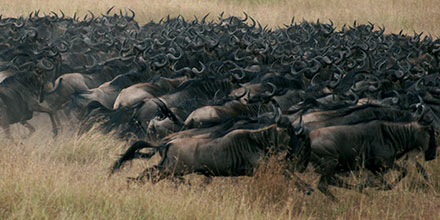
March, April, May and early June are known as the ‘long rains’ when torrential downpours can occur. The months of July through October are drier and cooler whilst late October brings the second rainy season, known as the ‘short rains’, which fall until the beginning of December. The short dry season then extends from mid-December to March with hot, rainless weather.
If you are travelling during the wet seasons you will almost certainly be treated to unexpected and exciting wildlife encounters, uncrowded game reserves & quite possibly a good deal of sunshine. During the drier months game viewing tends to be more reliable but it is also a busier time in terms of other tourists. It is worth noting that it can rain during any month and, with changing global weather patterns, predicting the actual weather for specific dates is becoming increasingly difficult. You should therefore pack with this in mind.
KEY SEASONS
- March to June: Long rains
- July to October: Peak season
- Migration: Herds are generally in the Maasai Mara from July to September
| AMBOSELI | JAN | FEB | MAR | APR | MAY | JUN | JUL | AUG | SEP | OCT | NOV | DEC |
|---|---|---|---|---|---|---|---|---|---|---|---|---|
| Temperature (°C) | 19-30 | 19-32 | 19-32 | 19-30 | 18-29 | 17-28 | 16-26 | 17-27 | 17-28 | 18-30 | 18-27 | 18-26 |
| Rainfall (mm) | 18 | 193 | 142 | 9 | 6 | 6 | 0 | 2 | 0 | 72 | 56 | 46 |
| NAIROBI | JAN | FEB | MAR | APR | MAY | JUN | JUL | AUG | SEP | OCT | NOV | DEC |
|---|---|---|---|---|---|---|---|---|---|---|---|---|
| Temperature (°C) | 12-25 | 13-26 | 14-25 | 14-24 | 13-22 | 12-21 | 11-21 | 11-24 | 11-24 | 13-24 | 13-23 | 13-23 |
| Rainfall (mm) | 38 | 64 | 125 | 211 | 158 | 46 | 15 | 23 | 31 | 53 | 109 | 86 |
| MAASAI MARA | JAN | FEB | MAR | APR | MAY | JUN | JUL | AUG | SEP | OCT | NOV | DEC |
|---|---|---|---|---|---|---|---|---|---|---|---|---|
| Temperature (°C) | 8-26 | 8-27 | 9-26 | 11-26 | 11-23 | 8-22 | 8-22 | 8-23 | 7-24 | 9-26 | 9-26 | 8-26 |
| Rainfall (mm) | 59 | 117 | 110 | 140 | 104 | 17 | 10 | 45 | 0 | 23 | 135 | 26 |
| SAMBURU | JAN | FEB | MAR | APR | MAY | JUN | JUL | AUG | SEP | OCT | NOV | DEC |
|---|---|---|---|---|---|---|---|---|---|---|---|---|
| Temperature (°C) | 11-27 | 11-28 | 9-26 | 10-25 | 11-23 | 11-23 | 10-24 | 10-25 | 9-26 | 9-26 | 9-26 | 8-26 |
| Rainfall (mm) | 1 | 38 | 79 | 91 | 53 | 46 | 92 | 111 | 3 | 12 | 89 | 15 |
LUGGAGE & PACKING
LUGGAGE
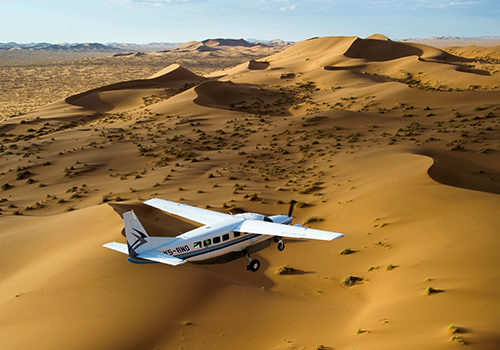
AFRICA: Charter flight companies and some safari operators impose strict luggage restrictions. The maximum luggage weight specific to your journey is 15 kgs including camera equipment and hand luggage for travel through Kenya Malawi Rwanda Uganda Tanzania // 20 kgs including camera equipment and hand luggage for travel through Botswana Namibia South Africa Zambia Zimbabwe. Your bags must be soft-shelled and malleable. If your luggage does not meet the criteria the charter companies will either leave your luggage behind, charge you for an extra seat onboard the aircraft (if one is available) or charter your bags separately at your cost. The charter planes have restricted space onboard, and, above all, the regulations are in place for your safety.
And if you are wondering how to pack everything in and keep it under 15kgs | 20kgs read our blog – How to pack for a safari and keep it under 15kg
CHARTER FLIGHTS
The luggage storage on many charter flights across Africa looks like this:
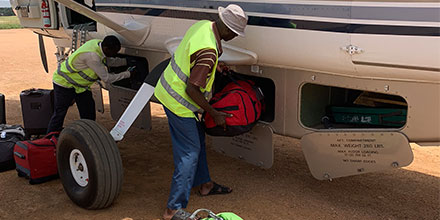
The weight limit is a strict safety requirement to ensure the balance and carrying capacity of small aircraft.
INDIA, MOROCCO ETC: Don’t take too much! You will regret bringing large unwieldy luggage & there is so much to buy in India. Most importantly please note that the space in the trunk/boot of your car can be relatively SMALL. So if you travel with a large, hard‐shelled suitcase you may have a problem getting your luggage to fit. Wheelie bags with soft sides are ideal, along with a small back pack or shoulder bag for day to day items. All luggage should also be capable of withstanding rugged treatment and please do note the size & weight restriction on domestic flights. If in doubt ask us!
We recommend you pack casual, light, cotton clothing for summer & extra layers in winter as it can be quite cold ‐ jeans, sweaters and a jacket are recommended. Evenings in summer can also be quite cool so packing an extra layer is recommended. It is best to travel in clothes that you feel most comfortable in, however you do need to be aware of cultural sensitivities. Women should dress discreetly and modestly.
Laundry is offered in almost every hotel, however, please note that clothes may sometimes be hand washed (depending on where you are) so avoid handing over delicate or expensive items if you are worried about them. Most hotels offer overnight laundry (at a cost) so there is no need for excess clothing. You may be requested, or may prefer, to do your own under garments.
NO PLASTIC BAGS
To protect the environment, wildlife, and human health over 80 countries now have a full or partial ban on single-use plastic bags. The Classic Safari Company also adopts this policy, and we encourage you to travel with a conscience and travel with no single use plastics. Please click this link for a full list of countries phasing out lightweight plastic bags.
YOUR WEIGHT
In addition to adhering to the luggage weight allowance on all charter flights you must also advise us if you weigh over 100kgs as you may be required to pay for an extra charter seat as the total weight of passengers + luggage must be safe for flying. There are NO exceptions and this is particularly important if the weather is hot. Please let us know prior to your arrival in Africa to save embarrassment at the time of boarding. The pilot has complete discretion over who and want is allowed on the aircraft – again, for the safety of all.
SAFARIS ON HORSEBACK
If you are joining a riding safari it is imperative that you advise us of your weight at the time of booking (and you inform us if your weight changes significantly prior to your holiday) in order that the riding safari outfitters can ensure an appropriate horse is available for you. Most riding outfitters have a preferred maximum weight limit of 90kgs. If you are close to or over this weight limit, please contact us. Depending on the riding outfitter you may be accepted as a rider based on your riding ability and experience. Failure to share this information may negatively impact your experience.

INSURANCE
ENSURE YOU’RE INSURED
Although we hope you’ll never need it, having a comprehensive travel insurance policy is always highly recommended. No international travel is ever entirely without risk, and even the best laid plans can go awry.
Whilst we cannot recommend the right policy for you (as only you know you and what you need), below we have provided links to sites and articles that may help you navigate your way through the choices available.
PLEASE NOTE: The information provided here is subject to change at any time. Please always read the travel insurers’ relevant Product Disclosure Statements and refer to the Australian Government’s Department of Foreign Affairs & Trade’s (DFAT) Smartraveller website for up to date travel advice and their advice on Travel Insurance.
Whichever insurer you choose please provide us with a copy of your chosen policy, insurance certificate and all emergency contact details for our records.
WHAT WE OFFER
The Classic Safari Company is currently associated with nib Travel Insurance. Their website is easy to navigate and, once you have entered your personal details and selected your preferences – such as adjusting your excess, adding cruise cover, increasing cancellation cover or declaring a pre-existing medical condition – a quote will be generated for your consideration. If you are satisfied with the cover outlined, you can follow the prompts to purchase your policy online.
As there are so many options and levels of cover that can be tailored to meet your individual needs, we do encourage you to contact your chosen insurer directly, or click the nib Insurance link above, to select a policy that is right for you.
At what point in the booking process should I purchase travel insurance?
It is advisable to obtain comprehensive travel insurance at the time of confirmation/paying a deposit to ensure you are covered from the moment you book.
What should I look for when selecting coverage?
Most insurance companies will cover the basics such lost luggage or flight cancellations, but levels of medical cover vary from policy to policy, and the cover for global issues, such as pandemics, has changed significantly over the past few years. This excellent article, Travel Insurance Simplified, published on 07 April 2022, details what you need to look for when selecting coverage for your next trip. Smartraveller also publishes helpful advice on Travel Insurance.
What is the impact of DFAT travel advice?
Some insurance will not cover travel to countries where the Australian Department of Foreign Affairs & Trade (DFAT) is warning Australians to “Reconsider your need to travel” (Level 3) and most don’t cover travel to places with a “Do not travel” warning (Level 4). Most international travel insurance covers visits to Level 2 countries. DFAT travel advisories can change over time and this may affect your travel insurance coverage. You should always check the advice levels on the Smartraveller website.
How much does travel insurance cost?
Costs will vary depending on your age, destination, duration of your journey, preferred excess, cancellation cover, and if you have any pre-existing medical conditions. It is important to note that the inclusions with each policy are different so price is not the only factor you should consider when choosing travel insurance – cheaper policies often don’t provide the cover you might expect. You should read the small print carefully before purchasing any travel insurance policy to ensure it is suitable for your needs.
Can I use my credit card travel insurance?
Many premium credit cards come with complimentary travel insurance. If you elect to only be covered by your credit card travel insurance it is paramount that you understand the terms and conditions, policy availability subject to your age, trip duration and destination, item limits, sub-limits and exclusions that may apply. It is also worth noting that many credit card travel insurance policies automatically exclude cover for epidemics and pandemics and may not cover charter flights.
What about reciprocal health care agreements?
If you’re travelling to one of the 11 countries for which Australia has reciprocal health care agreements, you may also be able to access free health care at your destination under these arrangements. The exact benefits available to Australians in each partner country vary. At a minimum, you can generally access emergency medical and hospital care in any of these 11 countries by simply showing your valid Australian Medicare card.
Even if you’re travelling to a country that has a reciprocal health care agreement with Australia, it’s still a very good idea to get travel insurance as these care agreements can be quite limited. Travel insurance will also cover you for everything else besides your health, such as delays or cancellations.
HEALTH & VACCINATIONS
VACCINATIONS
It may be necessary to take medical precaution prior to, and whilst travelling. As we are not qualified to offer advice, we recommend you contact your GP or the Travel Doctor-TMVC (*change hyperlink to country-specific*) who have the most up‐to-date information available. Requirements are highly personal depending on your health profile and the activities in your itinerary. Some vaccinations must be given well in advance of travel, so we suggest seeking medical advice as soon as you start to plan your trip. Be sure to ask what vaccinations or medications may be required to enter XXX and to re-enter Australia.
You can also refer to SmartTraveller (*change hyperlink to country-specific*) for a guide as to what may be required, however you should always seek professional medical advice before travelling.
In most major cities there are fully equipped hospitals with well provisioned dispensaries, often with the services of highly qualified and often overseas‐trained doctors/specialists available. Most first-class hotels also have doctors on call. If your itinerary includes travel to high altitudes be sure you are aware of the symptoms of altitude sickness and you carry the recommended medication. As modern dentistry is largely unknown in many rural areas ensure you have a check-up before you leave home.
STAY HEALTHY ON YOUR TRAVELS
- Cover up – use insect repellent, mosquito nets and wear long, loose, light-coloured clothing
- Drink boiled water or bottled water with sealed lids, except in lodges and hotels where water quality is tested and assured
- Don’t swim in fresh water unless told it is safe to do so
- Anything specific for India etc
NOTE: If you have the appropriate level of cover you may be able to claim a rebate through your private health insurance under your extras cover for part of the cost of your vaccines and anti-malarial medications. We recommend you check with your private health insurance company.
FOOD & DRINK
ADD TITLE HERE
Add content here
MENTAL PREPARATION
ADD TITLE HERE
Add content here
ADD TITLE HERE
Add content here
AIRPORTS & TRAVEL
AIRPORTS & FORMS OF TRAVEL
Refer to the India / Morocco PDI
MONEY MATTERS
CURRENCY AND EXCHANGE
Kenya’s currency is the Kenyan Shilling (Ksh), which is divided into 100 cents. Australian dollars cannot be exchanged for Kenyan Shillings so therefore it is recommended you travel with US dollars or Euro. Money can be exchanged at banks, at a Bureau de Change and often in larger hotels.
It’s best to take a mixture of money – credit card, debit card or travel cash card, plus cash just in case. Small denominations of USD or EURO are advisable – especially for tipping. If all else fails, have someone you can depend on who will make an emergency transfer of funds.
ATM machines are available in most cities & towns, are NOT widely available beyond that so do rely on these as your sole source of funds. Please be vigilant if you do withdraw cash.
Major international credit cards such as Visa and Mastercard are widely accepted. AMEX is not so popular and in some instances is not accepted at all. Please note that you need to take your physical credit card, and you need to know your PIN number, as not all places will allow you to ‘tap’. In some cases you may also be asked to sign.
It is recommended that you DO NOT change money on the black market as you are more likely to receive a lower rate of exchange or fake notes.
TELL YOUR BANK
We highly recommend you advise your bank of your destinations and travel dates. This should prevent any of your transactions being deemed as ‘out of the ordinary’ (and possibly stopped) due to their unexpected location.
TIPPING
Tipping is an ingrained part of tourism in Kenya.
Drivers, guides and hotel staff rely on tips to survive and it is likely you will feel like you are constantly tipping. Try to keep your wallet stocked with small denomination notes – either USD / EURO or the local currency.
And remember tipping is discretionary. If you have received exemplary service show your appreciation with a big tip – it will be appreciated.
As a guide you should expect to tip:
- Restaurants ‐ 10% of the bill amount, but always check if a gratuity has already been added to your bill before paying
- Drivers ‐ either tip daily or at the end of your trip if you have the same car & driver for a number of days. On a daily basis we suggest A$5 (or equivalent in local currency) from each person in your travelling party
- Tour guides – AUD$10 for a half day sightseeing tour and AUD$20 for a full day, per person
- Local representatives ‐ there is no need to tip the local representative who meets you at the airport or railway station, although if their service is above and beyond a tip will be appreciated
- Porters/hotel staff – A$2 per suitcase/backpack bag delivered to your room
Always carry extra money for those unexpected tips for drivers, guides or staff that deserve that bit extra.
SPENDING MONEY
It is extremely difficult to calculate exactly how much each person will spend, however, we suggest you budget around A$80‐$100 per person per day for extras such as additional meals, drinks and personal purchases. You can always bring the balance home if you don’t spend it.
We generally recommend you carry a combination of cash, Travel Debit Card, Debit card and/or a credit cards. Only take as much cash as you feel confident carrying and never keep your cash, credit card and/or debit card in the same place.
India & Morocco only:
Of course, if you plan to shop ’til you drop’ (and there is a lot of great shopping in India!) then budget accordingly!

POWER, TECH & PHOTOGRAPHY
POWER
There are basically two main voltage systems used around the world: 110 Volt ‐ USA, Canada, Spain & Japan 220 Volt ‐ the rest of the world. In simple terms, the power supply available at the socket is roughly twice as powerful in 240V countries as in 110V countries.
The voltage in XXXX is 220 Volts, therefore if you wish to use any electronic devices from Canada, the US or Japan you’ll need a voltage converter AND a plug adapter. Australia operates a 220V currency and therefore you only require an adapter for Australian appliances.
The adaptor you will need for XXXXX is a TYPE X or, alternatively you may prefer to invest in an International Travel Adaptor that provides you with more than one option.
Many adaptors also have a USB port so you can plug your smart phone, or I‐product directly into the adaptor.
For the latest & most up to date information about voltage and what adaptors to travel with refer to: www.korjo.com
ADAPTORS
Kenya uses a 240V electrical current and a type G socket (UK 3 square pin)

SMART PHONES & DATA
Smart phones can be wonderful travel companions. Not only will they help you stay in touch with friends and family, they’ll guide you through unfamiliar cities, enlighten you on local attractions, translate foreign languages and produce great photographs.
Left unchecked they can also wreak havoc with your travel budget!
The reason is that some (but not all) of the fun and useful functions smart phones perform require the downloading of data via an internet connection. Unfortunately, if you’re paying for data roaming it can be an expensive exercise and you run the risk of returning home to an expensive shock.
If you want to make the most of your mobile device, while avoiding unexpected and unpleasant charges, keep in mind the following tips:
- Buy an International Roaming Pack ‐ think about buying a pack from your phone network before departure in order to access cheaper rates
- Remove your regular SIM and replace it with a pre‐paid SIM either purchased before departure or upon arrival. Not only will you benefit from better prices for data, voice calls and SMS, but there will be a pre‐set limit on how much you can spend giving you some piece of mind.
- Turn off global roaming ‐ the problem with data roaming is not simply the exorbitant costs travellers are charged for downloading megabytes, it’s the fact that this data is often being sucked down without you even being aware of it.
To be safe, the easiest thing to do is simply disable data roaming.
We do NOT recommend taking advantage of free-wifi in public places such as airports and malls. The connection is often insecure, and you could run the risk of data & information theft. If you do need to go online, whether to check your emails, use a handy app or make an online booking – your best option is to find SECURE free or affordable Wi‐Fi.
PHOTOGRAPHY
Please respect local customs and feelings when taking photos. You may need to tip locals in order to take photos. It is forbidden to photograph certain places such as airports, dams, bridges, government buildings & military installations in many countries. If in doubt, ask!
CLASSIC SAFARI CO TRAVEL APP
Your very own App for travel – let the countdown begin!
The CLASSIC SAFARI CO App is supplied courtesy of The Classic Safari Company. It is a very handy tool with the upside being that you can view all your travel documents on your device at any time, whether connected to the internet or not. It will be where we house all your travel documents. Our App along with emailed digital copies of your travel documents, will be all that you will require once travelling.
Therefore, it is important to take the time to become acquainted with The Classic Safari Co App, and contents, well before you travel.
To start viewing your travel documentation you will need to download, at no cost, The Classic Safari Co App on your Phone, iPad or Tablet by following these steps:
- STEP 1 : Be sure you have internet access
- STEP 2 : Open the App store on your device and search for ‘The Classic Safari Co’ or download on the Apple App Store or Google Play
- STEP 3: Once installed and opened, you’ll be asked for your User ID and your Unique Passcode. Please enter the following:
- USER ID: TCSC
- UNIQUE PASSCODE: NAME+FILENUMBER
Click accept and wait for your travel documents to download before starting your journey on the App.
NOTE: If you prefer to access your trip details and documents on your personal computer, you can do so by visiting https://web.vamoos.com/. Please use the same user ID and unique passcode provided above.
HOW TO DOWNLOAD
Open the App store on your device and search for ‘The Classic Safari Co’. Alternatively, using your device click the icons below to download on the Apple App Store or Google Play


OUR APP LOOKS LIKE THIS:
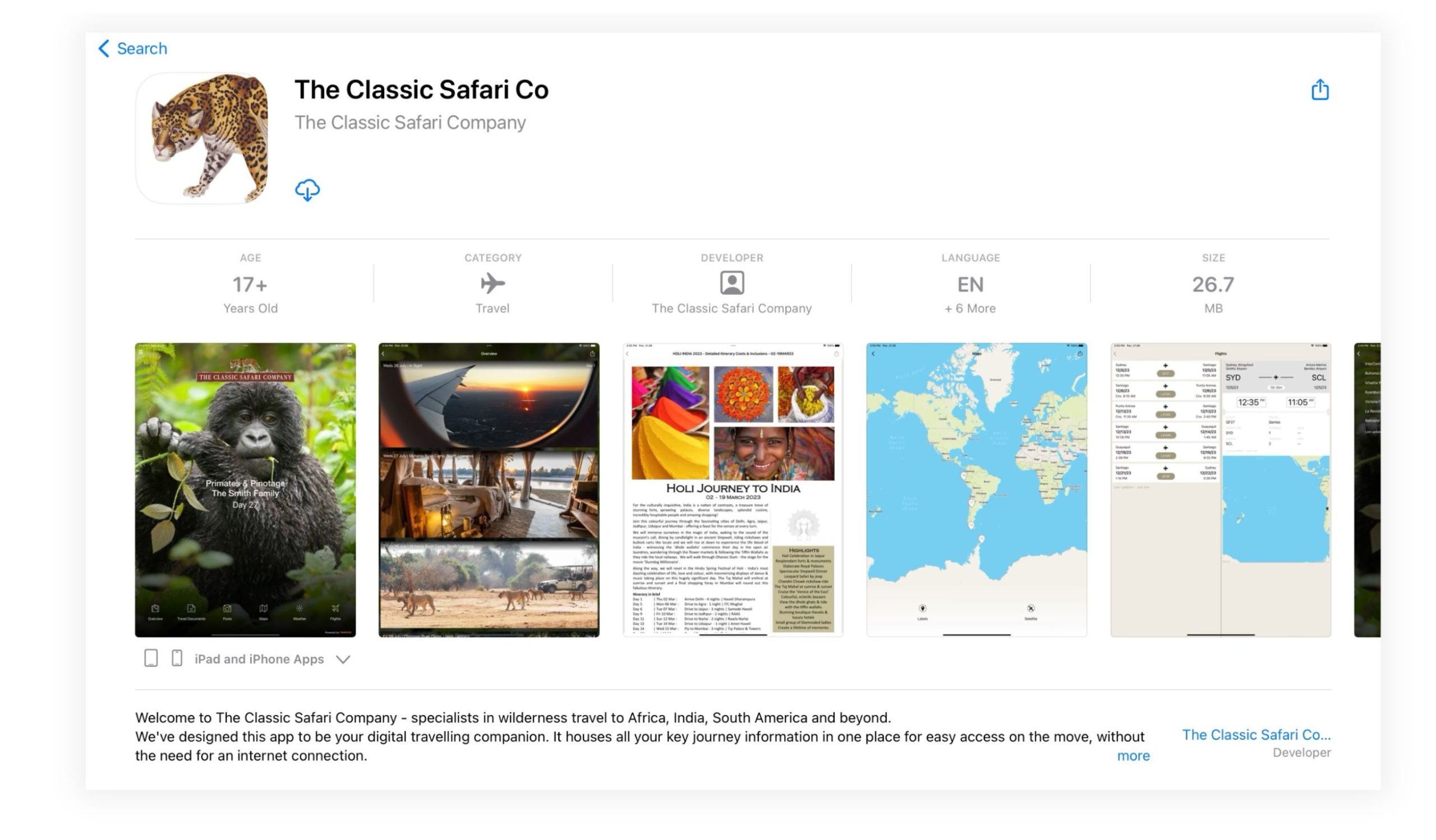
ON THE APP YOU WILL FIND:
- Your travel documents
- Destination information
- Maps
- Real time weather data
- E-tickets and flight information (if applicable).
ADDITIONAL OPTIONAL DOCUMENTS
We can also upload additional documents such as Tourist Visas, Vaccination Certificates, and your Travel Insurance Certificate if you wish to have them on hand as you travel. If you would like us to add these for you please email any additional documents in PDF format (only) and we will add them to your profile. We do not recommend adding or sharing your passport information online.
UPDATES & CHANGES
We will update all documents if and when changes occur, and prior to your departure we will furnish you with emergency contact information and any relevant travel vouchers.
OFFLINE USE
The greatest benefit of using our App is that once the initial download has occurred you will no longer require internet access to view what has been uploaded for you.
SECURITY
Please note that the software developer of our app (Vamoos) cannot guarantee the safety of personal data against identity theft, particularly if you are using a free wifi service whilst travelling. We do not recommend using free wifi services anywhere in the world.

ALREADY HAVE THE CLASSIC SAFARI COMPANY APP INSTALLED?
If you already have The Classic Safari Co App installed, to load a new trip you simply need to follow these steps:
- STEP 1: Open The Classic Safari Co App on your device and in the top left corner you will see 3 small horizontal lines (the burger menu). Click these and look for the words ‘Load New’… click this and then enter:
- USER ID: TCSC
- UNIQUE PASSCODE: NAME+FILENUMBER
- STEP 2: Wait for your travel documents to download before starting your journey on the App.
Should you have any questions about the App or the information uploaded for you please don’t hesitate to get in touch.
Thanks, have fun and let the countdown to your departure begin!